Portal and chat intake
A question arrives. A sourced answer goes back.
Most questions never reach a questionnaire. They are asked in a channel, in a portal, in a thread, and answered from memory by whoever is free. This page is what happens when they are answered from the same content the formal responses use.
From the question to the answer, in the same thread
Five steps, and the fifth is the one that makes the fourth worth doing. An answer nobody keeps gets asked again in a fortnight.
- 01
Someone asks, wherever they are
A rep in a Slack channel, a partner in Teams, a buyer in your vendor portal, a colleague in the web app. No new tool to open and no form to fill in first.
- 02
Matched to the same approved content
The question goes to the content the questionnaires and RFPs already draw on. Not a separate chat knowledge base that drifts from the formal one.
- 03
The answer comes back in the thread
With the documents it was drafted from named in the reply. The person who asked can check it without leaving the conversation or asking who wrote it.
- 04
Anything uncovered is routed, not guessed
Where approved content does not cover the question, it goes to the owner rather than being answered anyway. The thread shows that it was routed.
- 05
The answer is kept
Once an owner confirms it, the answer is available to the next person who asks and to the next questionnaire that needs it. Asked once, answered once.
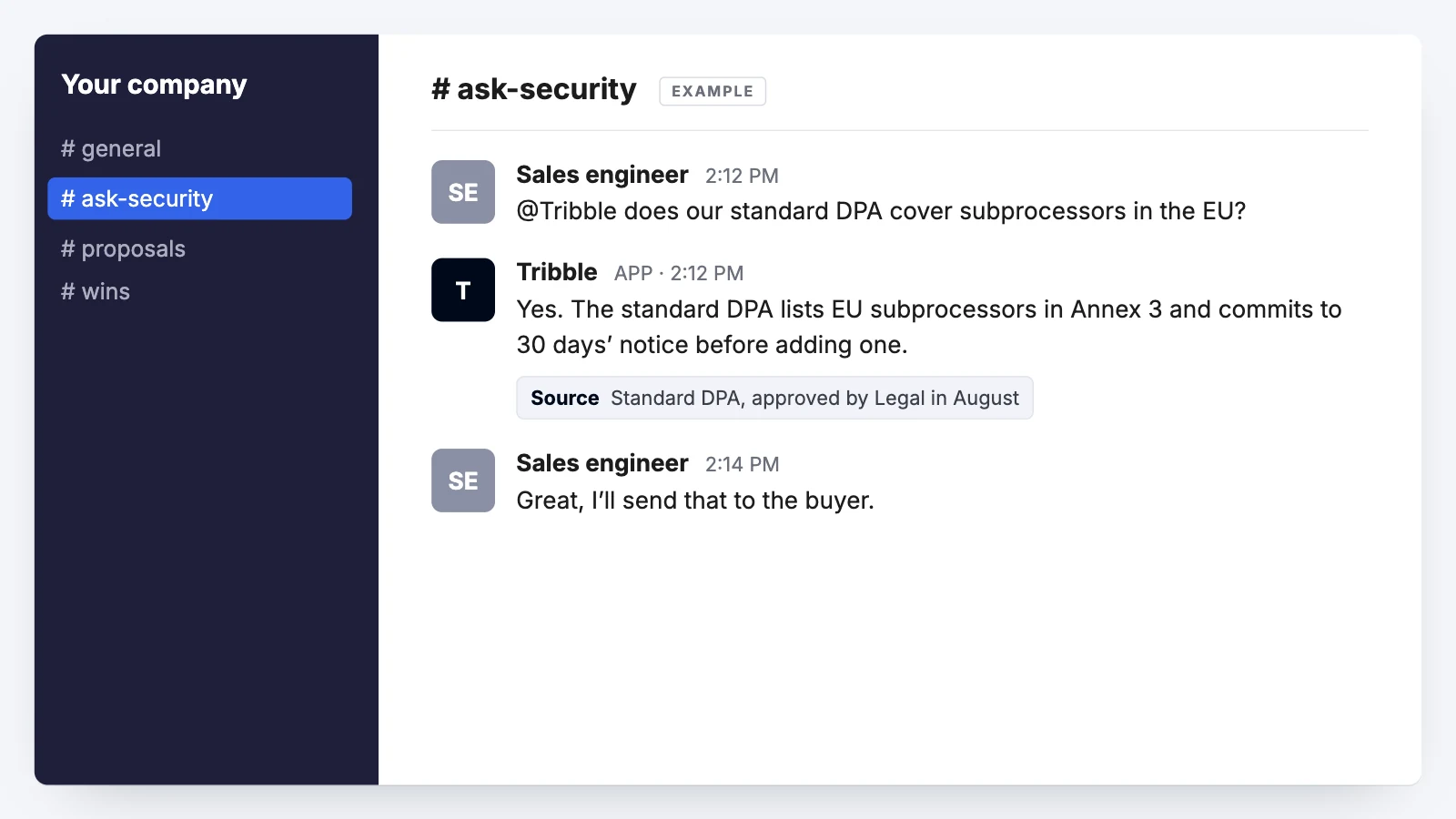
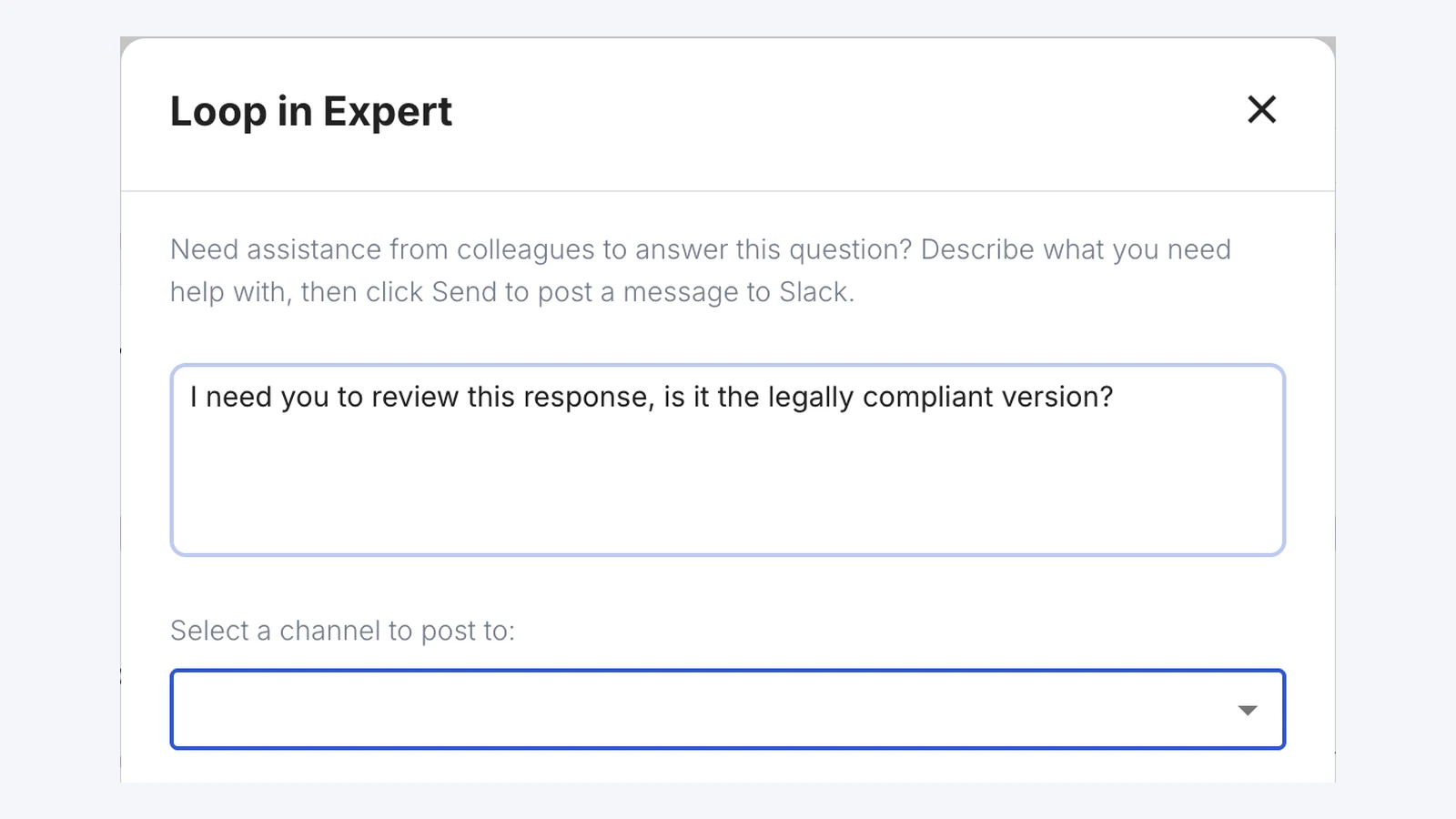
Why the chat answer and the formal answer agree
The reason to do this inside the response platform rather than beside it.
One set of approved content
The chat answer and the questionnaire answer are drawn from the same documents. A separate chat assistant with its own content is how the two end up disagreeing.
The source travels with the answer
The reply names what it was drafted from. An answer passed on to a buyer can be checked by whoever passes it on.
Routed, not guessed
An uncovered question goes to the owner and the thread shows that it was routed. Nobody has to work out whether silence meant no.
Answered once
A confirmed answer is kept and reused, in chat and in the next formal response. The same question asked in March is a questionnaire answer in June.
Permission aware
Source permissions carry through, and the check runs before the answer is drafted. Nobody receives evidence from a document they could not open.
The demand becomes visible
What gets asked, what gets routed, and which approved content is missing. In the first month this is usually more useful than the answers.
What the exchange actually looks like
Rendered rather than described. This is the format the answer arrives in, including what happens to the part nobody has approved.
Dana MercerSales, 09:14
Northwind are asking whether we support customer-managed encryption keys, and what the key rotation period is. Security call is at 11. Anyone?
Tribble09:14
Customer-managed keys are supported on Enterprise through AWS KMS, with the key held in your account. Default rotation is annual and configurable down to 90 days.
The part of your question about bring-your-own HSM is not covered by approved content, so I have not answered it. Routed to Priya Raman, who owns the encryption section.
- Security Architecture v3.2, p.14
- SOC 2 Type II, CC6.1
- Northwind security questionnaire, Q31 (answered 12 Aug)
Priya RamanSecurity, 09:31
Confirmed on HSM: supported on Enterprise through CloudHSM, available on request rather than self-serve. Safe to say so.
Tribble09:31
Saved. That answer is now available to anyone who asks, and to the next questionnaire with an encryption section.
Three moves in one exchange, and a general-purpose assistant makes none of them.
It named what it read
Three documents, one of them the answer this same buyer was given in August. Dana can check the claim before repeating it on a call at 11.
It refused the part it could not source
The HSM question had no approved content behind it, so no sentence was written. This is the move that makes the other two worth anything.
The confirmation was kept
Priya answered once. The next person to ask gets her answer, and so does the next questionnaire with an encryption section.
Where the question arrives
The surface is the point. A question only reaches a tool people already have open.
The questions that arrive this way, and what they cost today
None of these is a questionnaire. All of them end up in one eventually, which is why answering them from the same content matters.
Security and compliance
"Do you support SSO with our IdP, and where is data held for EU customers?"
Answered from the same approved security evidence a SIG or CAIQ draws on, with the policy named. The answer a rep gives in a channel becomes the answer in the questionnaire six weeks later, which is the only way those two agree.
What it costs today Asked of the one security engineer everybody knows, who answers it eleven times a month from memory.
Pricing and packaging
"What is on Enterprise but not on Growth, and can this be metered annually?"
Answered from the current packaging documentation rather than from the deck someone has open. The edition boundaries move, and an answer from an outdated deck is the kind that gets quoted back during redlines.
What it costs today Answered from a six-month-old pricing deck, then contradicted by the order form.
Legal and contractual
"Have we ever accepted unlimited liability on data breach, and what is our standard DPA position?"
Matched against positions legal has already taken on the same clauses, with the prior language attached. The useful answer is the precedent, not an opinion, and the precedent exists in documents nobody can search.
What it costs today Asked in a DM to legal, answered three days later, after the rep has already told the buyer something.
Product and roadmap
"Is SCIM provisioning shipped, in beta, or on the roadmap?"
Answered from current product documentation, with shipped, beta and roadmap distinguished. The honest answer is more valuable than the optimistic one, because an overstated yes surfaces in the pilot.
What it costs today Answered optimistically by someone who saw a demo of it, and discovered during implementation.
Competitive
"They are also looking at a competitor. What do we usually lead with?"
Answered from the competitive record and the win and loss history rather than from a battlecard someone last edited a year ago. Claims about your own capability are sourced; claims about a competitor are left to the deal team.
What it costs today Answered from a stale battlecard, which is worse than not answering, because it is confident and wrong.
Implementation and support
"How long does onboarding actually take for a team this size, and what do we commit to?"
Drawn from the methodology services runs and the SLA legal signs, rather than from the fastest deployment anyone remembers. This one becomes a commitment the moment it is said out loud on a call.
What it costs today The best-case timeline quoted as the normal one, which delivery then owns.
1,300+ people inside UiPath working on one Brain
The numbers below are from the workflow on this page, at the scale it was built for.

How this differs from what happens today
Three alternatives, and the first one is free, which is why it is the real competition.
| Tribble Respond | Asking in a channel | Searching the wiki | ChatGPT or Claude | |
|---|---|---|---|---|
| Who answers | Approved content, then an owner where needed | Whoever is free and feels confident | You do, from whatever you find | A model, from whatever it was given |
| The answer carries a source | Documents named in the reply | Rarely, and never a document version | You found it, so you know | No way to tell |
| When nothing covers it | Routed to the owner, visibly | Silence, or a guess | You stop looking | Answered anyway, fluently |
| Permissions | Checked before the answer is drafted | Whoever answers decides | Whatever the wiki enforces | Whatever was pasted in |
| The answer is kept | Reused in chat and in the next response | Lost in the thread | Only if someone edits the page | Nothing persists |
| Agrees with the formal response | Same content, checked across both | Only by coincidence | If the wiki is current | Unaware the response exists |
| You can see what is being asked | Demand, routing and content gaps | Scroll back through channels | Page view counts | Nothing is recorded |
The questions this gets asked on the first call
Not the objections a vendor prepares for. The ones that decide whether it is worth switching a channel on.
"We already have a channel where people ask this."
You do, and it works until the person who answers is on leave or until two of them answer differently. The cost is not the asking, it is the eleven times a month one engineer answers the same question and the fact that none of those answers is kept.
"We tried a chat assistant and it made things up."
That is the failure mode, and it is why an uncovered question here is routed rather than answered. A visible gap is the designed behaviour, not a shortfall. If a bot that confidently invents answers is the comparison, the relevant difference is that this one refuses.
"Will this leak things to people who should not see them?"
Source permissions carry through and the check runs before the answer is drafted, not after. Nobody receives an answer drawn from a document they could not already open themselves.
"What stops the chat answer contradicting the questionnaire?"
They are the same content. A separate chat assistant with its own knowledge base is exactly how a rep tells a buyer something the security questionnaire contradicts a fortnight later, and that is the specific failure this is arranged to prevent.
The pattern across all four: the competition is not another tool, it is asking a colleague. That is free, fast and usually right, and it fails in three specific ways. It does not scale past the one person who knows, it leaves no record, and it does not agree with what you put in writing.
Where it reads from
The content stays where it is. Permissions come with it.




Questions that come up on intake
The ones asked on nearly every call.
How does Tribble answer questions in Slack or Teams?
Tribble runs in the channel or as a direct message. A question asked in the thread is matched against the same approved content the questionnaires and RFPs draw on, and the answer comes back in the thread with the source documents named. Where approved content does not cover the question it is routed to the owner rather than answered, and once an owner confirms an answer it is kept and reused.
Is this a different knowledge base from the one used for RFPs?
No, and that is the point. A separate chat assistant with its own content is how a rep ends up telling a buyer something the questionnaire contradicts two weeks later. The chat answer and the formal answer come from the same approved content and are checked against each other.
Which surfaces are supported?
Slack, Microsoft Teams, the Tribble web app, and direct intake from vendor portals. Questions arriving by email can be routed in as well.
Does it respect who is allowed to see what?
Yes. Source permissions carry through, so nobody receives an answer drawn from a document they could not already open. The permission check happens before the answer is drafted, not after.
What happens when it does not know?
It says so and routes the question to the owner, in the same thread. An answer with nothing behind it is the failure mode this is built to avoid, so a visible gap is the intended behaviour rather than a shortfall.
Can we see what is being asked?
Yes. The questions coming in are visible as a body of demand: what is asked most, what is routed most often, and which approved content is missing. That is usually the most useful output in the first month.
Does answering in chat make the formal responses better?
It should, because confirmed answers are kept and feed the same content the questionnaires draw on. A question a rep asks in March is a questionnaire answer in June.
How does pricing work?
Annual platform editions based on response volume, included projects, included Sales Agent users and enterprise requirements. The pricing page carries the current structure.
Read next
The other response workflows this runs on.
RFP automation
The same content, when the questions arrive two hundred at a time.
Security questionnaires
SIG, CAIQ, VSA and a buyer’s own spreadsheet.
DDQ automation
Investor and operational due diligence, from fund documentation.
Long-form responses
The narrative sections, with a source on every claim.
How UiPath did it
1,300+ people and 350+ partners on one Brain.
Tribble Respond
The product all five workflows run on.